
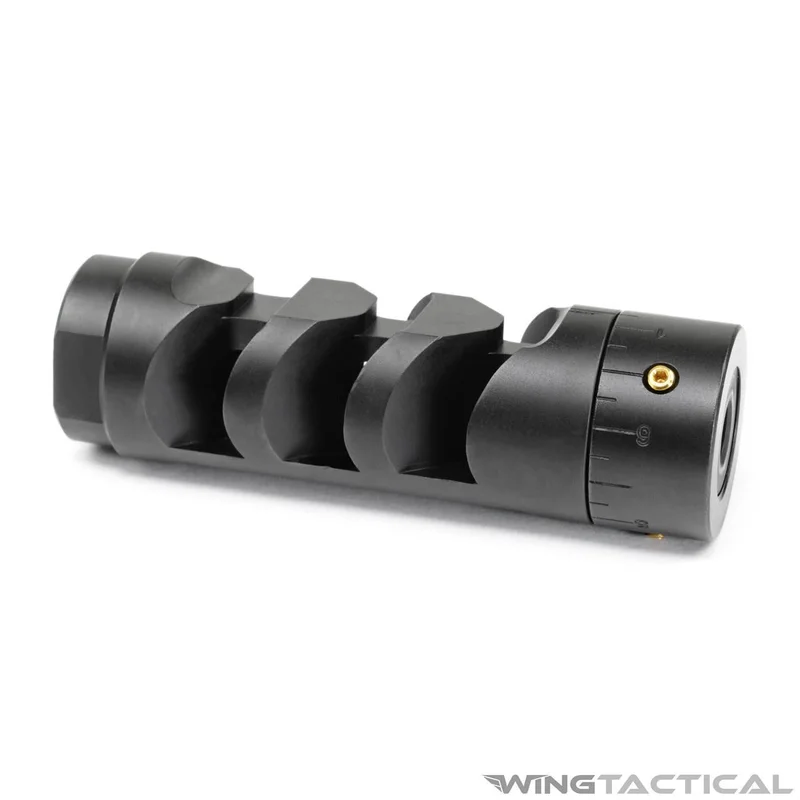
Description
MPN: ARM1931-BLK
Features:
1/2×28 AR-15 Fitment: .223/5.56 version for standard AR-15 barrelsno adapters, no guesswork
Brake + Tuner in One: Cuts recoil and lets you tune barrel harmonics for tighter, repeatable groups
Tool-Simple Adjustments: Dial settings with a hex screw; follow the on-page step method to find your rifles sweet spot
Duty-Ready Finish: QPQ black nitride resists wear and corrosion
Patented Design: Purpose-built for precision on AR platforms
Specifications:
Caliber: 5.56 NATO / .223 Rem.
Material: Steel
Finish: Black Nitrite
Weight: 5.11 oz.
Length: 2.93″
Outer Diameter: 0.94″
Bore Diameter: 0.25″
Thread: 1/2″-28
Compatibility:
.223/5.56 barrel with 1/2″-28 thread pitch
Includes:
1x Armaspec Harmonics-Tuner Muzzle Brake (.223/5.56)
1x Crush Washer
Details:
Most muzzle brakes focus on recoil. Armaspecs Harmonics-Tuner Muzzle Brake adds something more useful: a built-in tuner you can adjust to your barrel and the ammo you actually shoot. The front section threads in and out in small increments, letting you nudge barrel harmonics toward a setting that prints tighter groupswithout changing loads or chasing a different velocity node.
Set it up once, then dial it in at the range
Setup is straightforward. Install the brake on your 1/2×28 .223/5.56 barrel, time it, and confirm a baseline group. Then loosen the lock screw, rotate the tuner a small step, lock it, and shoot another group. Walk those adjustments until you see the pattern settle. When you hit the sweet spot, tighten the screw and leave it there. Youll get the expected reduction in muzzle rise from the brake, plus more consistent impacts with your preferred ammunition.
Built to live at the muzzle
The housing is sized for real use at the muzzle. A 7/8-inch OD keeps the profile trim while still giving the ports enough volume to work. The body is made from steel with QPQ black nitride finish to deal with heat, carbon, and weather, and all adjustments are done with a basic hex keyno fixtures or shop time required. If you like to verify changes at the range and move on, this is built for that.
Why choose this over a standard brake
Compared with a standard muzzle brake, the value here is flexibility. You still get flatter tracking and faster shot-to-shot recovery, but you also gain a practical way to stabilize groups for a specific barrel/ammo pairing. Its a small change that shows up every time the sight picture snaps back onto steel or paper.
If you want a 5.56 muzzle brake that doesnt just manage recoil but helps your rifle shoot more consistently, this tuner-brake strikes a useful balance of control, durability, and easy field adjustment.
How to Tune Your Harmonics Tuner for Optimal Accuracy
Follow this step-by-step process to tune your harmonics tuner and improve your rifles group consistency.
Tuning Instructions:
Start at Zero
Set your tuner to the 0 position.
Shoot a Group
Fire a 3-shot group at your target.
Be consistent with your aim and note the group size.
Adjust the Tuner
Increase the tuner setting by 2 increments (e.g., go from 0 to 2).
Shoot Another Group
Fire another 3-shot group at the same point of aim.
Observe and record the group size.
Repeat the Process
Continue increasing the tuner in steps of 2 (e.g., 0 2 4 6, etc.), shooting a 3-shot group at each setting.
Track your group sizes carefully.
Watch for Group Degradation
Keep increasing in steps of 2 until you notice that your groups start getting larger or less consistent.
This means youve likely passed the optimal tuning range.
Refine the Setting
Once the group size starts to worsen, go back to the previous setting that gave you the best result.
From there, make smaller adjustments (e.g., in steps of 1 or 0.5) to fine-tune and zero in on the best setting.
Lock It In
When you’ve found the setting that consistently produces the smallest group, lock it in place.
Reviews
There are no reviews yet.